CPRG hosts 'PadhAI 2.0' to advance AI in Indian education at India AI Impact Summit 2026
Feb 17, 2026
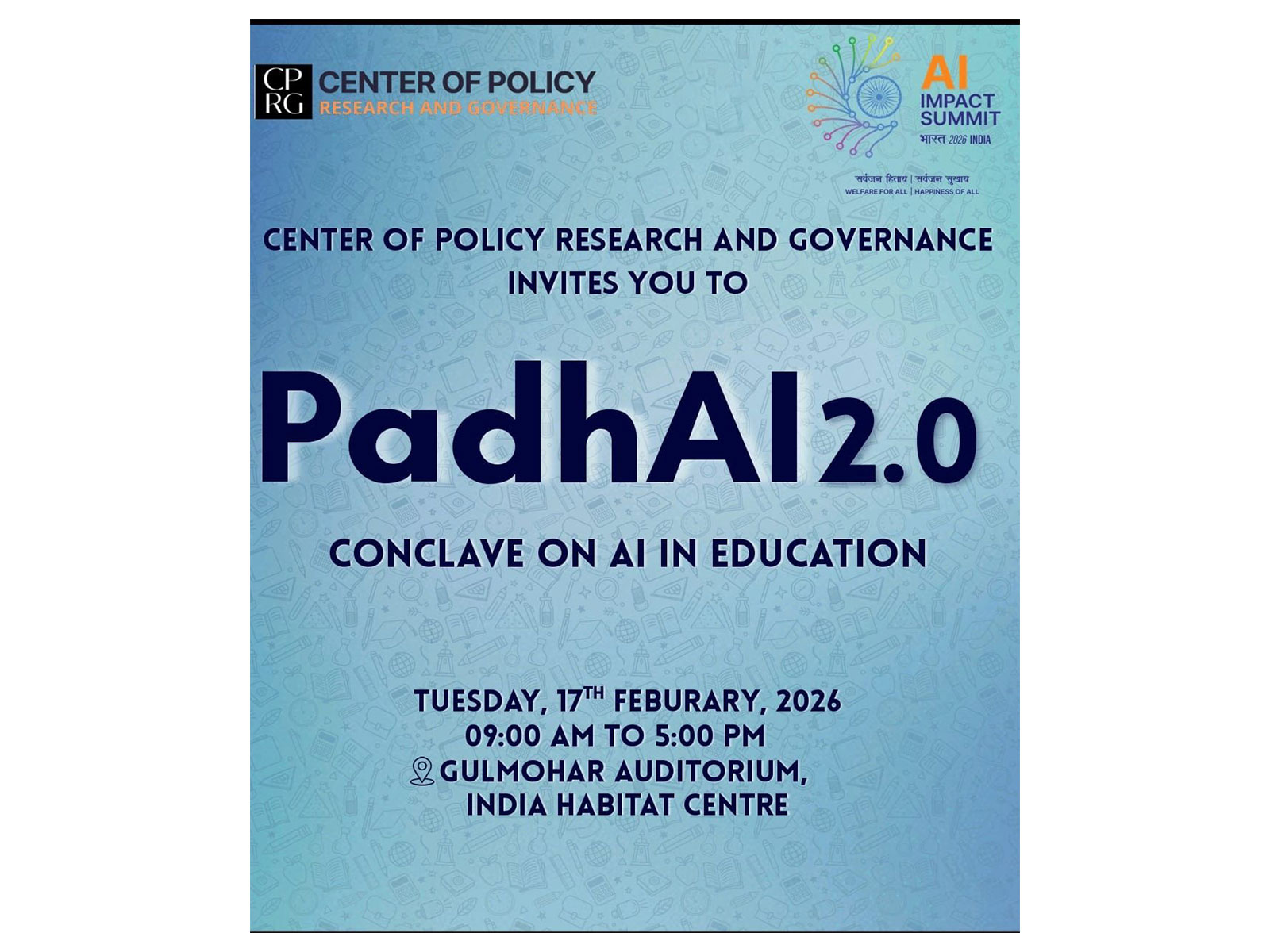
New Delhi [India], February 17 : The Centre of Policy Research and Governance (CPRG) on Tuesday hosted "PadhAI 2.0: Reimagining the Indian Education System" in the national capital as a main event of the India AI Impact Summit 2026, focusing on the integration of artificial intelligence (AI) in India's education ecosystem.
Building on the dialogue initiated during PadhAI 2025, the conclave brought together senior policymakers, institutional leaders, and industry experts to explore how AI is transforming governance, pedagogy, and learning outcomes across schools and higher education institutions. The session was convened by Dr Ramanand, Director, CPRG, who highlighted the need to move from aspiration to action in AI adoption in education.
Reflecting on the broader objectives of the conclave, Dr Ramanand, Director, CPRG, added, "From PadhAI 1.0 to PadhAI 2.0, our effort has been to advance a serious conversation on the impact of AI in education. As these technologies expand, we must democratise access, strengthen regional and vernacular learning, and ensure institutions across the country are prepared to engage with AI in meaningful ways."
He further added that "At CPRG, our research across higher education and employment shows that AI is already influencing how students learn and how industries hire. The focus now must shift from discussion to preparedness, capacity building and responsible adoption at scale."
Ashish Sood, Minister of Education, Government of NCT of Delhi, who remarked, "AI must remain a tool that strengthens learning, not replaces it. In the end, the most critical element of AI is not the algorithm, but the human using it. As we integrate these technologies in education, our focus must stay on students, parents and teachers, and on expanding access with responsibility."
The inaugural session also featured remarks by Shashi Shekhar Vempati, Former CEO of Prasar Bharati, who reflected on the evolving role of institutions and leadership in steering responsible AI adoption in education.
The Conclave also witnessed an important milestone with the signing of a Memorandum of Understanding (MoU) between the Centre of Policy Research and Governance and the Inter University Centre for Teacher Education (IUCTE).
The MoU was formalised by Dr Ramanand, Director, CPRG, and Prof Prem Narayan Singh, Director, IUCTE. At a time when AI is reshaping classrooms, this partnership is significant for strengthening teacher training in AI literacy and developing ethical, context-aware pedagogical frameworks, laying the foundation for sustained capacity building in education.
Anne Neuberger, Former Deputy National Security Advisor for Cyber and Emerging Technology, United States, emphasised that AI in education must remain people-centred and outcome-driven. She highlighted its potential for personalised learning, accessibility for students with disabilities, early intervention through data, and stronger teacher-AI collaboration.
The dialogue forms part of CPRG's Future of Society initiative, which examines how emerging technologies are reshaping governance and public institutions. In the lead-up to the India AI Impact Summit 2026, CPRG organised a series of pre-summit engagements across India and internationally. Notably, CPRG was the only Indian non-governmental organisation to host an official side event at the Paris AI Action Summit 2025. During the Summit period, CPRG is convening multiple main summit events to contribute to the ongoing conversation on responsible AI and technology policy.
As part of this broader engagement, the second edition of the PadhAI Conclave on AI in education deepened the national dialogue, shifting focus from possibility to practice. CPRG will pursue the policy recommendations generated from these insightful discussions to inform India's policies.