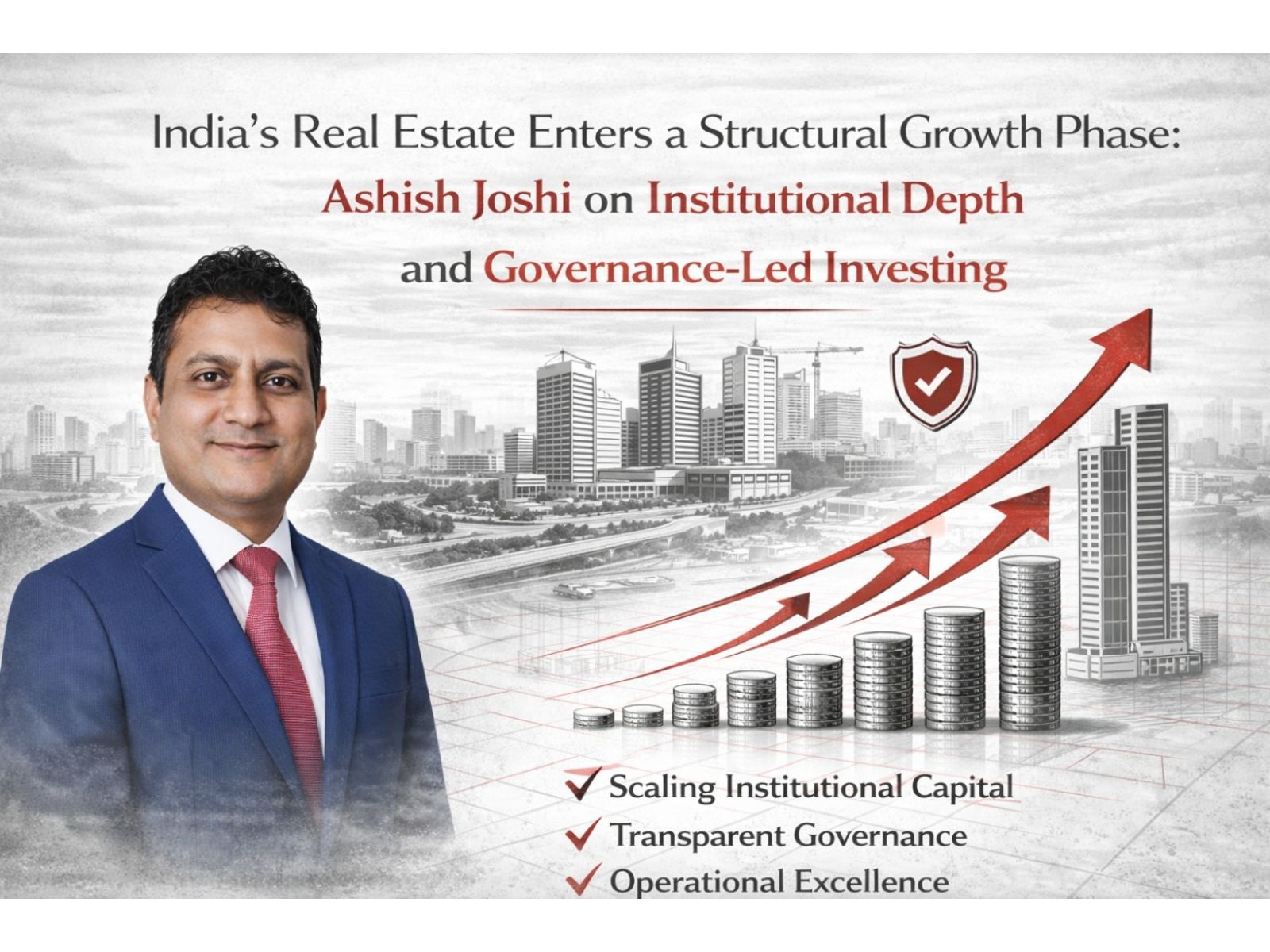
India's Real Estate Enters a Structural Growth Phase: Ashish Joshi on Institutional Depth and Governance-Led Investing
Feb 26, 2026
PNN
Mumbai (Maharashtra) [India], February 26: India's real estate sector is transitioning from cyclical expansion to structural consolidation. What was once largely liquidity-driven is now increasingly shaped by institutional capital, regulatory discipline, and income-oriented investing.
According to Ashish Joshi, Founder of Landmark Capital Advisors, Indian real estate is entering a phase defined less by speculative appreciation and more by structural fundamentals.
"This is not merely another upcycle. We are witnessing ecosystem-level strengthening -- from regulatory transparency to institutional participation and capital sophistication," says Joshi.
A Structural Shift Backed by Data
India remains the fastest-growing major economy, with GDP projected to expand at 6-7% annually over the medium term (IMF estimates). This macro resilience is translating into sustained real estate capital flows.
- Institutional investments in Indian real estate crossed ~USD 5-6 billion annually in recent years (JLL, CBRE reports).
- Over the past five years, cumulative institutional inflows have exceeded USD 25 billion.
- Office, logistics, and residential assets account for the majority of this capital allocation.
- REIT and AIF participation has deepened capital markets transparency.
Unlike previous cycles, capital today is increasingly long-duration and yield-focused.
"Allocator conversations have evolved," Joshi notes. "The focus has shifted from aggressive IRR targeting to income durability, downside protection, and asset-level governance."
Institutional Capital Is Reshaping Market Behavior
Institutional participation -- both global pension funds and domestic capital pools -- is redefining investment frameworks.
Recent trends indicate:
- Global Capability Centers (GCCs) leased over 40% of Grade-A office space in major Indian cities in the past year.
- India's total Grade-A office stock has expanded from ~450 million sq ft a decade ago to over 800 -900 million sq ft, with projections exceeding 1.2-1.3 billion sq ft by 2030.
- Logistics and warehousing stock has grown rapidly, supported by e-commerce expansion and supply-chain realignment.
Beyond volume, the nature of capital has changed:
- Structured vehicles
- Asset-level reporting
- ESG and sustainability integration
- Phased deployment strategies
This signals a transition from momentum-driven allocation to process-driven capital deployment.
Office Real Estate: Flight to Quality
India continues to attract multinational corporations and GCC expansion across Bengaluru, Hyderabad, Mumbai, Pune, and NCR.
Gross office leasing in recent years has typically been in the 50-70 million sq ft annual range, with 2025 touching over 80 million sq ft, placing India among the largest global office markets.
However, growth is increasingly selective:
- Prime Grade-A assets show strong occupancy resilience.
- Secondary inventory faces pricing and vacancy pressure.
- Sustainability-certified buildings command rental premiums of 8-12% in certain micro-markets.
"Quality-led dispersion will define performance," says Joshi. "Tenant strength and asset management discipline will matter more than broad market optimism."
Residential: From Momentum to End-User Stability
India's residential sector has seen strong recovery:
- Annual housing sales across top 7 cities crossed 300,000+ units in recent peak years (Anarock, PropEquity data).
- Inventory overhang has reduced significantly from prior-cycle highs.
- Premium and luxury segments have outperformed, particularly in Mumbai, NCR, and Bengaluru.
However, the structural shift suggests normalization rather than overheating.
Demand is increasingly:
- End-user driven
- Supported by urban income growth
- Anchored in demographic strength (median age ~28 years)
Landmark Capital Advisors emphasizes underwriting discipline in this phase:
- Developer governance
- Execution timelines
- Capital structuring
- Cash flow visibility
"Risk must be evaluated holistically, particularly in under-construction and premium segments where capital deployment spans multiple years," Joshi explains.
Governance as Competitive Advantage
Regulatory evolution -- including RERA implementation, REIT frameworks, and strengthened AIF compliance -- has enhanced transparency.
Institutional allocators now assess:
- Reporting standards
- Risk frameworks
- Incentive alignment
- Capital recycling discipline
"Governance is no longer a compliance checkbox -- it is a performance driver," says Joshi.
Platforms that embed governance into structuring philosophy are increasingly preferred by long-term capital.
The Rise of Income-Oriented Strategies
Historically, valuation expansion drove a meaningful share of returns in Indian real estate. With cap-rate compression moderating in prime markets, the next phase will emphasize:
- Rental growth
- Net operating income (NOI) expansion
- Leasing execution
- Structured refinancing
India's REIT market, now managing USD 15+ billion in assets, has demonstrated investor appetite for stabilized, income-generating assets.
Institutional investors are increasingly favoring:
- Stabilized commercial portfolios
- Hybrid income-growth strategies
- Operational value-add frameworks
"Income visibility will anchor future performance," Joshi notes. "Operational alpha will separate outperformers from passive participants."
Operational Alpha: The Next Differentiator
As markets mature, execution becomes central to value creation:
- Leasing expertise
- Asset repositioning
- Sustainability integration
- Financial engineering
- Structured exits
Landmark Capital Advisors focuses on phased capital deployment and volatility management frameworks to enhance long-term credibility.
"India's growth story remains compelling. But the composition of returns is evolving," says Joshi.
Looking Ahead: Precision Over Expansion
India's structural growth shift reflects maturation, not slowdown.
Urbanization, infrastructure development, demographic advantage, and supply-chain repositioning continue to support real estate demand. However, broad-based appreciation is giving way to selective, governance-led growth.
According to Ashish Joshi, the next decade will reward:
- Governance integrity
- Asset-level precision
- Income durability
- Operational excellence
"The future of Indian real estate belongs to disciplined capital."
As India advances through this structural transformation, real estate appears less driven by speculative cycles and more by institutional depth -- where strategic clarity and execution excellence will ultimately determine long-term success.
(ADVERTORIAL DISCLAIMER: The above press release has been provided by PNN. ANI will not be responsible in any way for the content of the same.)