Lok Sabha passes SHANTI Bill to modernise, open up nuclear energy sector for private participation
Dec 17, 2025
New Delhi [India], December 17 : Lok Sabha on Wednesday passed the Sustainable Harnessing and Advancement of Nuclear Energy for Transforming India (SHANTI) Bill, 2025, aimed at modernising India's nuclear energy laws and opening up the sector for private companies to operate nuclear reactors and plants.
The bill, which seeks to repeal the Atomic Energy Act, 1962 and the Civil Liability for Nuclear Damage Act, 2010, was passed as opposition staged a walkout, during the ongoing Winter Session.
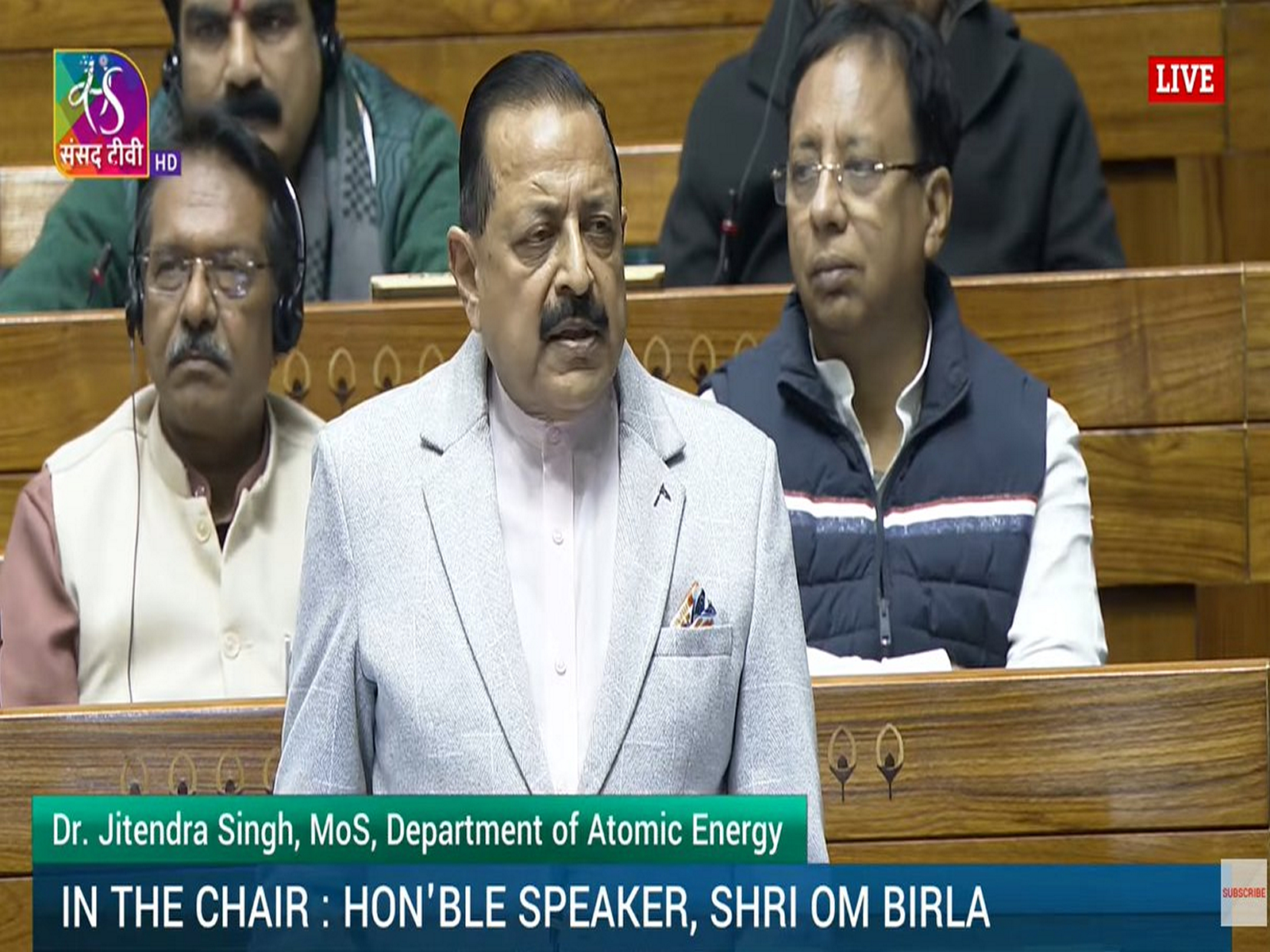
Addressing concerns raised by members and outlining the government's rationale for introducing a comprehensive new nuclear law, the Union Minister of Science and Technology and Atomic Energy Jitendra Singh said the Bill seeks to modernise India's nuclear framework in line with contemporary technological, economic and energy realities, while retaining and strengthening core safety, security and regulatory safeguards that have been in place since the Atomic Energy Act of 1962.
The SHANTI Bill which was tabled in Parliament on December 15 also opens avenues for participation by public sector entities, government companies, joint ventures and other companies, subject to strict national security and safety safeguards.
It provides for the promotion and development of nuclear energy and ionising radiation for nuclear power generation, application in healthcare, food, water, agriculture, industry, research, environment, innovation in nuclear science and technology, for the welfare of the people of India, and for robust regulatory framework for its safe and secure utilisation and for matters connected therewith or incidental thereto.
Singh earlier today introduced the Bill the Lok Sabha, which he termed as a historic bill which will transform the future of India and the next generation of Indians.
Replying to the discussion on the Bill, the Minister said this Bill will give a new direction to the country's developmental journey. Section 9 of the Bill, he said, allows individuals to undertake innovation and research.
"Another section empowers the Government to restrict the involvement of certain companies for security reasons. This is not a new Bill; we have simply modified certain aspects of it," the Union minister said.
Responding to Opposition members who opposed the Bill, the Minister said many Opposition parties are opposing the Bill without reading it thoroughly, he says.
"They are opposing it for the sake of it," he said. "Our government has defined the Bill properly, and we have given more of authorisation and independence to private parties involved. The Bill strengthens mechanisms related to safety, security, safeguards, quality assurance and emergency preparedness."
The Bill seeks to provide a comprehensive legal framework for the promotion, regulation and expansion of nuclear energy and radiation applications in the country and produce 100 gigawatts of nuclear energy by 2047.
The Bill aims to strengthen India's nuclear power programme while enabling wider application of nuclear science and technology across sectors such as healthcare, agriculture, water, food processing, industry, research and environmental protection. It also seeks to modernise the regulatory architecture in view of emerging technologies, including artificial intelligence-enabled nuclear and radiation applications.
The proposed legislation provides for a robust licensing and safety authorisation regime for the production, use and management of nuclear energy and radioactive substances. It lays down detailed provisions governing the establishment, operation and decommissioning of nuclear power plants, research reactors, fuel fabrication facilities and radiation facilities.
A key feature of the Bill is the statutory backing for the Atomic Energy Regulatory Board (AERB), which is deemed to be constituted under the new law.
The AERB will function as the central regulator for nuclear safety, radiation protection, security and safeguards, with enhanced powers for inspection, investigation and enforcement. The Board is also mandated to ensure transparency through structured public outreach while protecting restricted information.
The Bill introduces an elaborate framework on duties and liabilities, including civil liability for nuclear damage. It caps the maximum liability for each nuclear incident at the rupee equivalent of 300 million Special Drawing Rights, with the Central Government assuming liability beyond the operator's limit in specified cases.
Provision has also been made for mandatory insurance or financial security by operators to cover potential liabilities.
In line with India's three-stage nuclear power programme and closed fuel cycle policy, the Bill reserves certain strategic activities, such as enrichment, reprocessing of spent fuel and high-level radioactive waste management, exclusively for the Central Government or its wholly owned entities. At the same time, it exempts specified research, development and innovation activities from licensing requirements to promote scientific advancement and private-sector participation.
The legislation also provides for the establishment of specialised bodies such as the Atomic Energy Redressal Advisory Council and the Nuclear Damage Claims Commission for adjudication of disputes and compensation claims arising from nuclear incidents. Stringent penalties and punishments have been prescribed for violations, along with powers for search, seizure and investigation.
The bill is intended to support India's clean energy transition, ensure round-the-clock power supply for advanced technologies such as artificial intelligence and quantum computing, and facilitate the long-term utilisation of the country's abundant thorium resources. Once enacted, the proposed law will repeal and subsume certain existing provisions and establish a safe, secure and sustainable expansion of nuclear energy in India.