Middle powers forge new tech alliances as global power rivalry intensifies
Mar 05, 2026
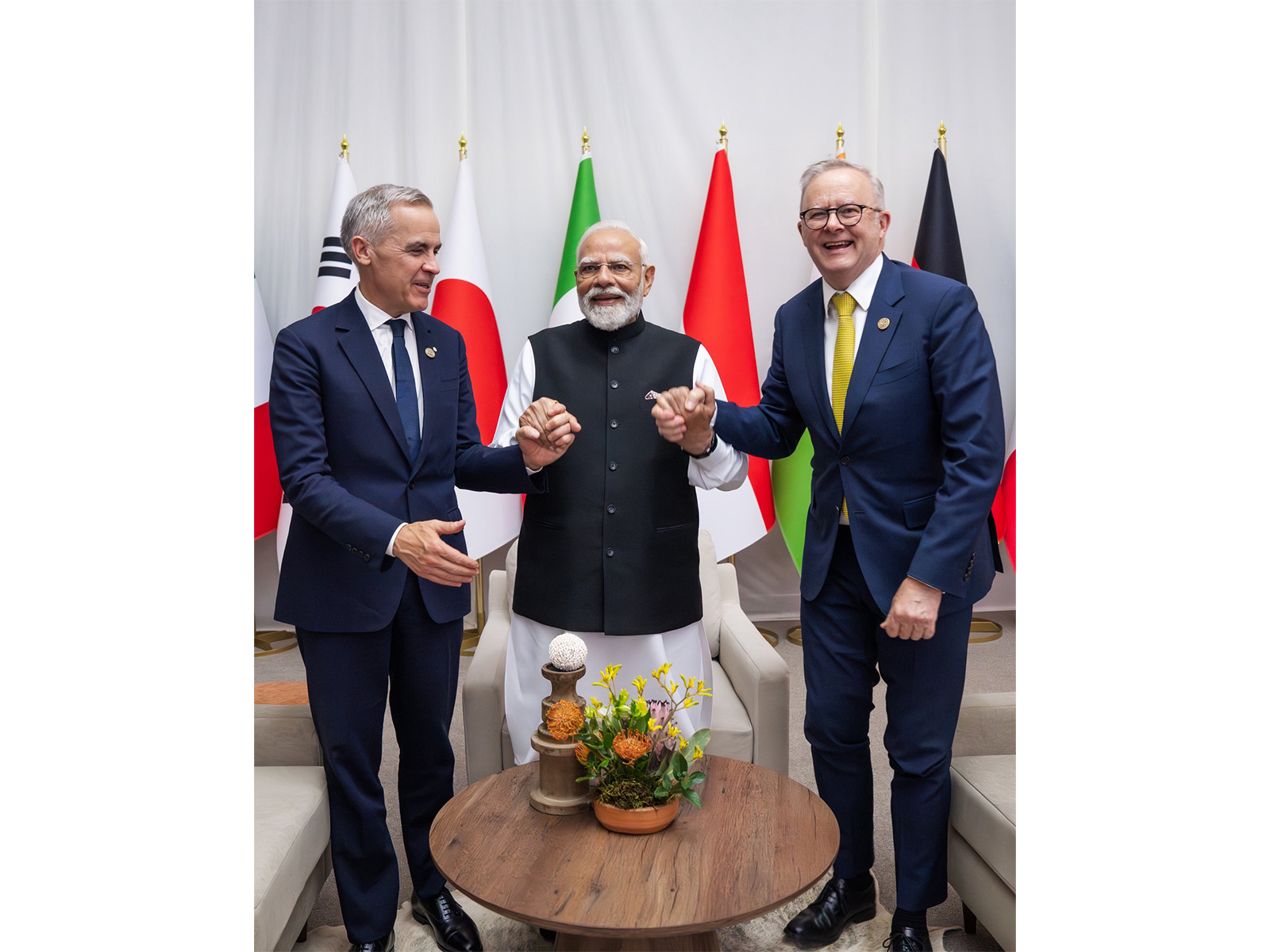
Stockholm [Sweden], March 5 : A new strategic partnership among Australia, Canada, and India is emerging as middle powers look for innovative ways to navigate an increasingly fragmented global order.
According to an issue brief titled "Changing Geometries: The Rise of a Middle-Power Tech Triangle" by the Institute for Security & Development Policy, the three countries are exploring deeper cooperation in technology and innovation to reduce dependence on dominant global powers.
The brief describes that the global system is no longer in a phase of gradual transition but rather experiencing a sharp rupture. Economic interdependence, once seen as a stabilising force under US-led globalisation, is now being weaponised. Supply chains, trade networks, and technological ecosystems have increasingly become arenas of strategic competition.
Against this backdrop, middle powers are reconsidering their strategic options.Rather than turning inward through protectionist policies and economic self-sufficiency, some are experimenting with flexible coalitions built around shared interests and values. The Australia-Canada-India Technology and Innovation (ACITI) Partnership is presented as a key example of this "variable geometry" approach.
The proposed partnership seeks to strengthen cooperation in critical and emerging technologies, including artificial intelligence, semiconductors, quantum computing, and clean energy systems. By pooling technological capabilities and research resources, the three countries aim to build resilient supply chains and reduce vulnerabilities linked to geopolitical tensions.
India's growing digital economy and technological workforce are expected to play a central role in the partnership. Meanwhile, Canada's research ecosystem and Australia's advanced capabilities in critical minerals and strategic resources complement India's innovation landscape. Together, the three countries could form what analysts describe as a "tech triangle" capable of shaping technology governance and standards in the Indo-Pacific and beyond.
The brief also notes that collaboration between these countries aligns with broader efforts to diversify global technology networks. In a period marked by US-China rivalry and rising protectionism, middle powers are increasingly seeking cooperative frameworks that allow them to maintain strategic autonomy while strengthening economic resilience.
However, the success of the initiative will depend on political commitment, policy coordination, and sustained investment in research and development. Experts suggest that, if effectively implemented, the tech triangle could serve as a model for other middle-power partnerships seeking to adapt to the rapidly evolving geopolitical landscape.