Mumbai-Ahmedabad Bullet Train project sees progress in track installation using Japanese J-slab system
Apr 22, 2026
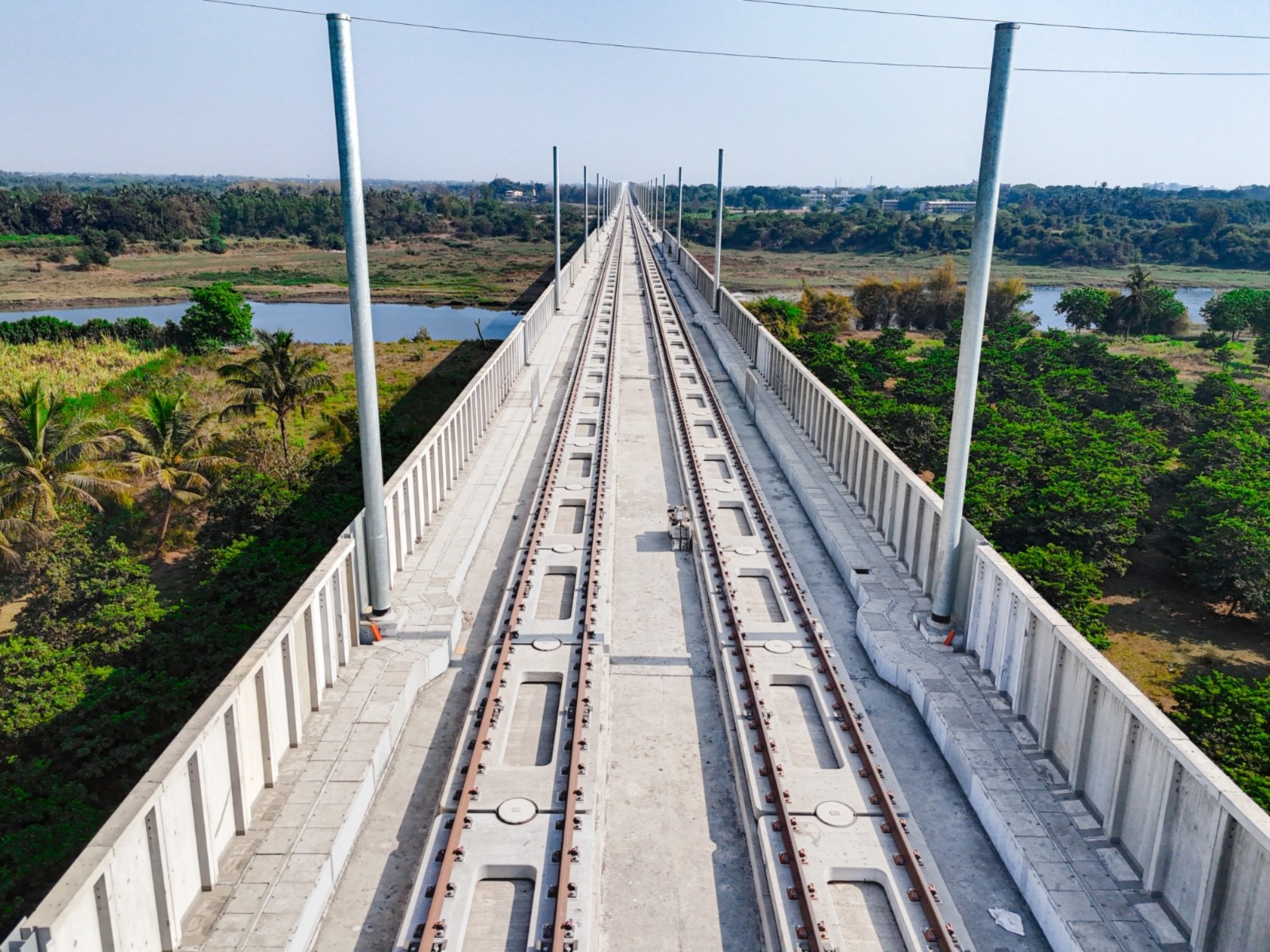
Ahmedabad (Gujarat) [India], April 22 : Track installation work on the Mumbai-Ahmedabad Bullet Train project is progressing steadily, with the adoption of the advanced J-Slab ballastless track system based on the Japanese Shinkansen technology, which is being used for the first time in India, according to an official statement by the National High Speed Rail Corporation Limited (NHSRCL).
The NHSRCL stated that the J-Slab track system comprises four key components--RC Track Bed, Cement Asphalt Mortar (CAM), Pre-cast Track Slab, and rails with fasteners--designed to support high-speed train operations.
To support the production of track slabs, two state-of-the-art Track Slab Manufacturing Facilities (TSMF) have been set up at Kim near Surat and Anand in Gujarat. These facilities are producing high-grade concrete slabs with precise dimensions to ensure a consistent supply for the project.
The slabs are stored at the factory and transported via trailers to Track Construction Bases (TCBs), which act as operational hubs for handling materials, machinery, and equipment both on the ground and at the viaduct.
At present, ten TCBs are operational--four between Surat, Bilimora and Vapi, and six between Vadodara, Anand and Ahmedabad.
National High Speed Rail Corporation Limited (NHSRCL) is a government-owned entity, specifically a "Special Purpose Vehicle" (SPV). It is a joint venture company involving the Central Government through the Ministry of Railways (50% equity) and the state governments of Gujarat (25%) and Maharashtra (25%).
According to the statement, significant progress has been made in track construction. A total of 185 route km of RC Track Bed has been laid, while 188 route km of track slabs have been manufactured. Additionally, track slabs have been laid and CAM injected across 70 route km.
The company also added that the track installation process is fully mechanised and uses specialised machinery designed as per Japanese construction practices, with most equipment manufactured in India.
Among the key machines being used is the Flash Butt Welding Machine (FBWM), which welds 25 m long 60 kg rails into 200 m long panels at the TCB. These welded rails undergo strict approval processes to ensure they are fit for high-speed operations at 320 kmph. Training and certification for rail welding and inspection have been conducted by the Japanese company JARTS.
The Track Slab Laying Car (SLC) is used to lift and place precast slabs onto the viaduct, with the capacity to handle five slabs at a time. Meanwhile, the Rail Feeder Car (RFC) is used to transport and lay 200 m long rail panels over the track bed.
After slab placement, the Cement Asphalt Mortar Injection Car (CAM Car) is deployed to inject the CAM mixture beneath the slabs, ensuring proper alignment and levelling of the track.
The adoption of advanced technology and mechanised processes is expected to enhance the efficiency and precision of track installation for India's first high-speed rail corridor.