Pakistan Army-backed terror attacks hinder normal ties: New NCERT Class VII book
Dec 08, 2025
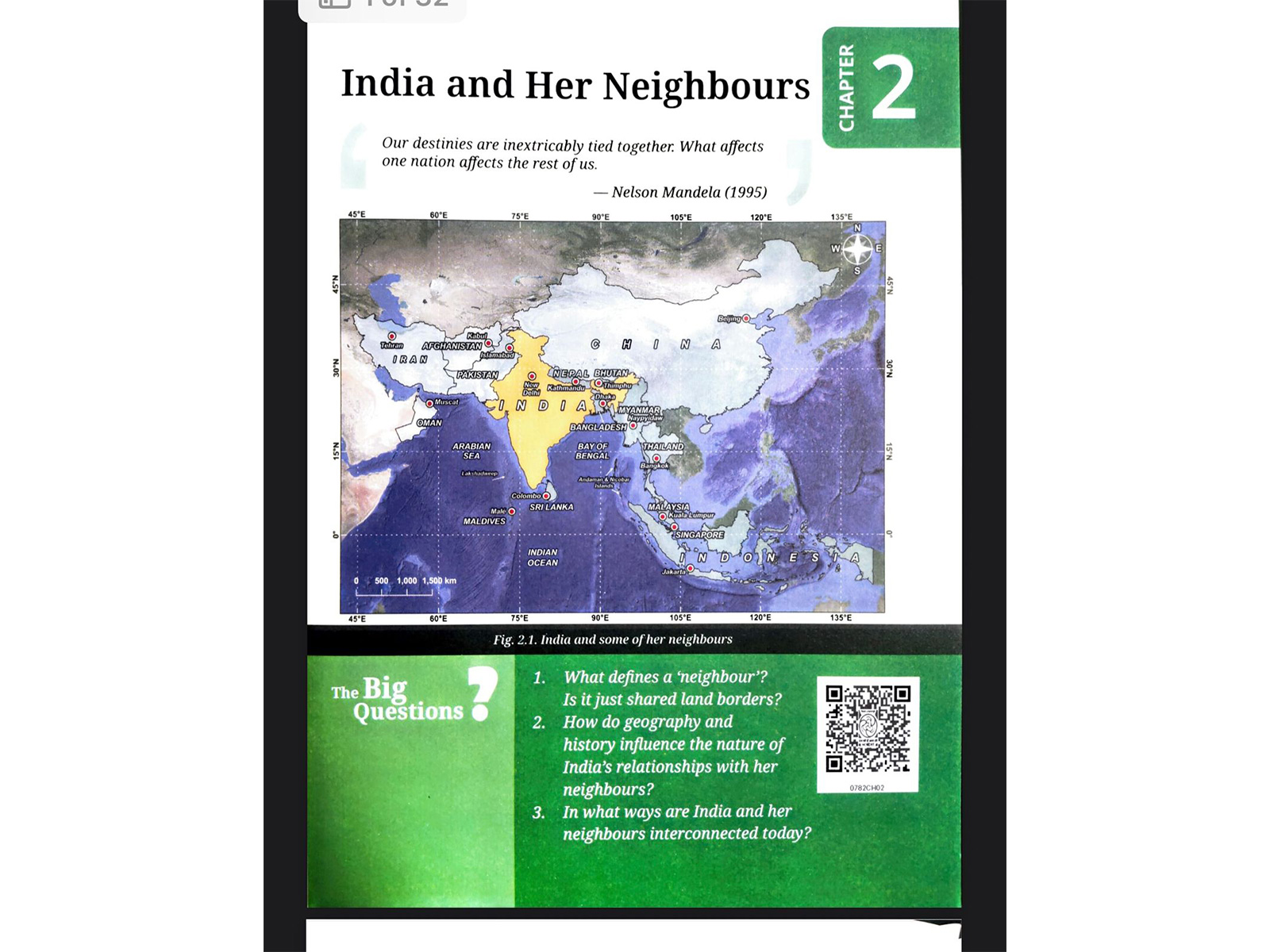
New Delhi [India], December 8 : NCERT's new Class VII Social Science book has introduced a chapter on India's neighbours, noting that Pakistan Army-backed terror attacks have hindered India-Pak normal ties.
The book also underlines that efforts are underway with China to resolve disputes through trade and dialogue.
The 31-page chapter --India and Her Neighbours--expands the idea of neighbourhood beyond land borders to maritime partners. It states that the book uses this broader lens "to situate India's central and strategic place in South Asia."
This chapter has been newly introduced in the Class VII book --Exploring Society India and Beyond--and did not exist in the previous edition.
On China, the chapter underlines long civilisational links and recent friction. The book describes India and China as two of Asia's largest and most Influential nations with Buddhism have a powerful link between the two countries.
"In recent years there have also been phases of heightened tensions, mostly related to their shared borders and a few serious conflicts... On the other hand, efforts are being made to resolve disputes through trade, dialogue and border resolution mechanisms," it notes.
In the 'Dont Miss Out' box, there is also a mention of the Hindu merchants who built temples in the Chinese port city of Quanzhou, an important trading centre in 13th Century. At the Kaiyuan temple, pillars depict carvings of Vishnu, Shiva, and stories from the Ramayana and the Puranas.
The section on Pakistan calls bilateral ties among the most difficult in the region, shaped by Partition and four major conflicts.
In one of its strongest lines, the book says, "Frequent terrorist attacks launched against India with the support of the Pakistan Army have prevented normal relations between the two countries."
The chapter adds that the India-Pakistan border is "not just a geographical line, but also a symbol of shared heritage as well as a tragically divided history."
The chapter also gave an overview of the Kartarpur Corridor, which makes it easier for thousands of people to visit Gurdwara Darbar Sahib in Kartarpur.
.
"For decades, Indian devotees could only view this holy site from a distance, using binoculars set up near the border at Dera Baba Nanak in Punjab. The idea for a corridor was first proposed in the 1990s but only became a reality in 2019, when the corridor was officially opened to mark Guru Nanak's 550th birth anniversary," the book mentions.
In Bangladesh, the text points to a close partnership anchored in history, rivers and culture. It says the two nations share "an enduring relationship shaped by a common history, culture and language," and describes it as one of India's most important regional ties.
India-Nepal relations are framed around open borders and deep cultural connections. The book explains that their arrangement "allows citizens to cross freely without passports or visas, enabling people on both sides to access education, healthcare, employment and maintain family connections."
With Bhutan, the chapter highlights hydropower cooperation and Buddhist heritage, calling the bilateral bond "a relationship marked by mutual respect, strategic cooperation and cultural affinity."
On Sri Lanka and the Maldives, the book underscores ancient cultural overlap and modern strategic cooperation, noting India's repeated emergency assistance to its island neighbours, including during the 2004 tsunami and the 2014 Male water crisis.
The chapter also traces India's historic imprint across Southeast Asia -- Thailand, Malaysia, Singapore and Indonesia -- through maritime trade and the spread of Buddhism, Sanskritic names and epics. It notes how these connections shaped regional art, literature and religion over centuries.
The concluding section says India's ties with neighbours draw from long civilisational flows.