President Droupadi Murmu attends Vijay Diwas 'At Home' marking India's victory in 1971 War
Dec 15, 2025
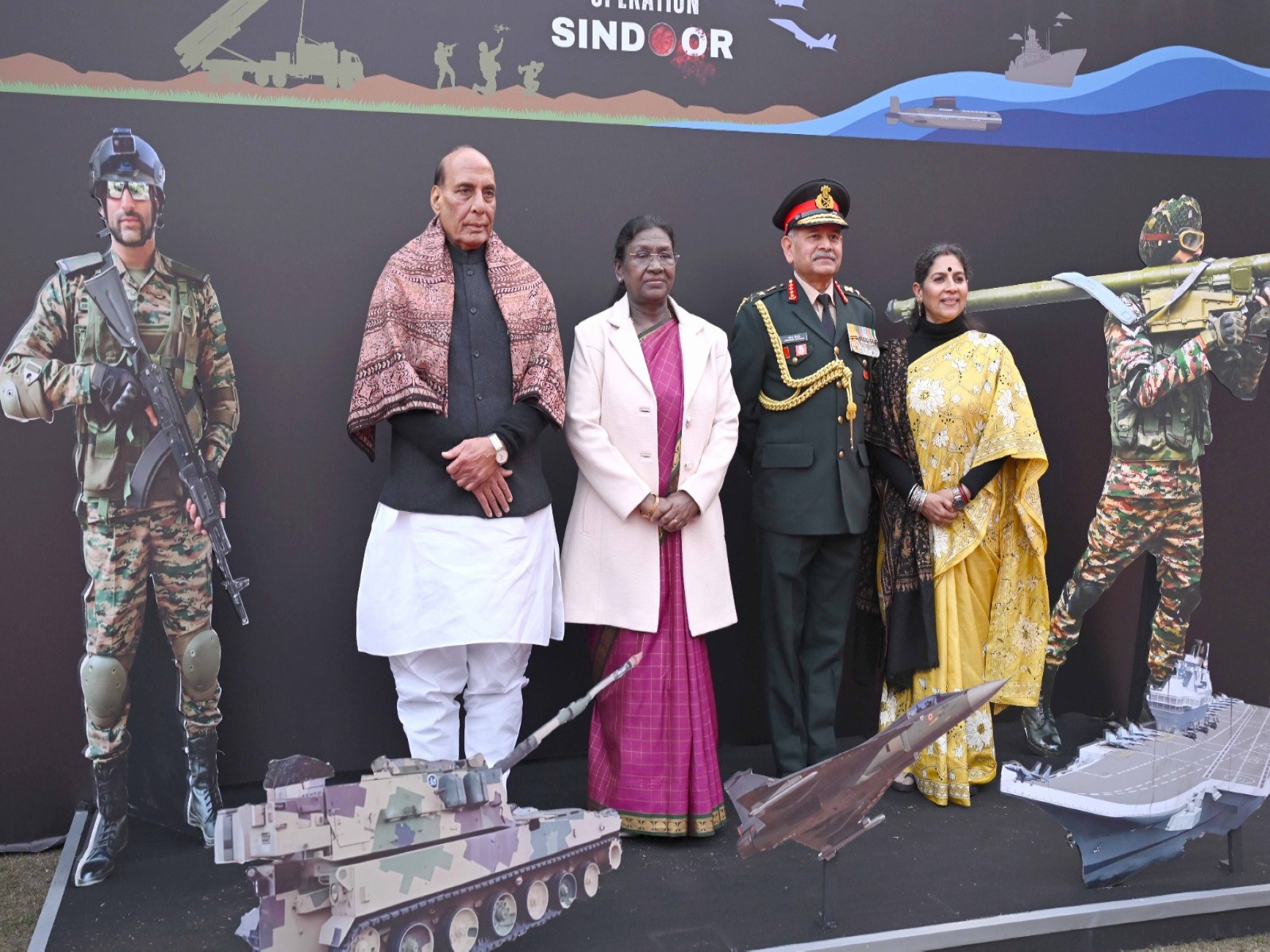
New Delhi [India], December 15 : President Droupadi Murmu on Monday attended the Vijay Diwas 'At Home' in Army House, New Delhi, to commemorate Vijay Diwas, marking the decisive victory of the Indian Armed Forces in the 1971 War, a press release from the Ministry of Defence said.
Defence Minister Rajnath Singh was also present at the ceremony.
The 'At Home' featured an impressive showcase of indigenously developed technologies and niche capabilities, reflecting the Indian Army's steady transformation into a modern, innovative and self-reliant force.
As part of the Vijay Diwas 'At Home' celebrations at Army House, the Indian Army showcased a wide range of homegrown technologies and innovations, underscoring its steady transformation into a modern, self-reliant and future-ready force. The displays reflected how Indian soldiers, engineers, startups, and academic institutions are working together to develop solutions that strengthen national security while also delivering strong benefits for disaster response, infrastructure development, and sustainability.
According to the press release, the presence of a large number of guests, including 73 Ambassadors and High Commissioners alongside Gallantry Award winners, Sportspersons, Achievers from varied fields and senior Indian leadership, underscored India's expanding global defence engagement and the growing international confidence in the Nation's homegrown military technologies. The brief about the equipment and technologies demonstrated is given in the succeeding paragraphs.
A key highlight was an AI-based satellite imagery analysis system that helps interpret satellite pictures quickly and accurately. Instead of manually studying images, the system uses artificial intelligence to identify changes, track developments and flag important observations. Developed with Indian startups and academic institutions, the technology supports better planning, monitoring and decision-making. While it strengthens the Army's awareness and preparedness, the system can also support civilian agencies in areas such as disaster monitoring, land management, agriculture assessment and infrastructure planning. The initiative demonstrates how advanced technology developed for defence can directly support national development.
The Indian Army also displayed a compact, portable AI system designed to function even in areas with no internet or network connectivity. This 'AI-in-a-Box' allows users to analyse information, plan tasks and receive decision support independently. Built to work in tough conditions, the system ensures that technology remains available even in remote locations. Developed with Indian research institutions and industry partners, it highlights how artificial intelligence can be adapted to Indian conditions rather than relying on imported solutions, the release said.
The same technology can also support disaster relief teams and emergency planners working in isolated regions. It offers dual-use strategic capabilities, including intelligence automation, real-time situational awareness, vision-based inspection, logistics forecasting, process optimisation, and training simulations, making it a force multiplier for the Armed Forces as well as government agencies and critical national infrastructure.
The Indian Army showcased Ekam AI, a fully indigenous and secure artificial intelligence platform designed for sensitive environments. It enables users to analyse information, manage documents, and support decision-making without dependence on foreign software or external cloud systems. Built for ease of use, it allows personnel at different levels to leverage AI-enabled support without requiring specialised technical expertise. By ensuring complete data security and sovereignty, Ekam AI marks a significant step towards building trusted national digital systems, the ministry said.
The Army also presented a drone analysis system developed in India to study recovered drones and extract useful information. The tool helps understand how drones were used and supports better preparedness against emerging threats. Its development reflects the Army's proactive approach to new technologies.
Under Project SAMBHAV, the Army showcased a portable communication system that provides mobile connectivity using satellite support. The system can be deployed quickly in remote or disaster-affected areas, improving communication for both soldiers and civilians. The project highlights how defence innovation can also strengthen the national communication infrastructure.
The Indian Army showcased an indigenously developed Advanced Truss Bridge, designed to quickly restore connectivity across rivers, gaps and damaged roads. Unlike older bridge systems that required large teams and long assembly times, this new bridge can be erected much faster using fewer personnel. Its strength allows it to support heavy vehicles, while its modular design makes transportation and assembly easier in difficult terrain. Beyond military use, the bridge has significant value during floods, earthquakes and landslides, where rapid restoration of road links is critical for civilian relief and rescue operations. Fully designed and produced in India, the bridge reflects the Army's focus on faster response, reliability and self-reliance.
According to the release, the Indian Army presented a made-in-India all-terrain vehicle developed specifically for narrow, steep and rugged mountain tracks where conventional vehicles cannot operate. Designed after extensive field trials, the vehicle can carry supplies, evacuate injured personnel and support rescue operations in high-altitude and remote areas. Its development was driven by the practical experience of soldiers working in extreme conditions. Built in partnership with the Indian industry, the vehicle reduces dependence on foreign platforms and demonstrates how Indian engineering can deliver solutions tailored to local terrain and requirements.
One of the most innovative displays was a trackway system made using recycled plastic waste. These trackways are laid temporarily over soft or broken ground to help vehicles move safely and smoothly. Compared to older systems, the new version is lighter, easier to handle and quicker to deploy. Importantly, it also supports environmental sustainability by converting plastic waste into useful infrastructure. This initiative reflects the Army's commitment to green practices while improving mobility and shows how operational needs and environmental responsibility can go hand in hand.
A new electric tactical vehicle developed in India was also on display, reflecting the Army's shift towards cleaner and quieter mobility. The vehicle operates with very low noise and heat, improving safety and efficiency. It can be used for patrol, logistics support, casualty evacuation and reconnaissance. The platform demonstrates how electric and hybrid technologies can be adapted for demanding operational conditions while reducing fuel dependence and environmental impact.
The Indian Army highlighted a major achievement in indigenising a critical component used in night-vision devices. Earlier imported at high cost and with long supply delays, this component is now manufactured in Army workshops using Indian technology. The move significantly reduces costs, improves availability and ensures faster repairs. This step strengthens operational readiness while saving public resources. The technology also has potential applications beyond defence, including medical equipment and scientific research, reinforcing the broader value of defence-led innovation.
As per the release, the Army displayed an unmanned firefighting robot designed to operate in dangerous fire zones where human entry is risky. Controlled remotely, the robot uses cameras and sensors to help firefighters tackle intense fires from a safe distance. Its use can save lives in defence installations, industrial areas and disaster situations. Developed under the iDEX initiative with the Indian industry, the robot highlights how automation can improve safety and efficiency in emergency response.
An innovative pre-fabricated shelter system was showcased, designed to be assembled quickly in remote and high-altitude areas. These shelters reduce construction time, manpower and logistics, while providing improved safety and protection. The solution reflects the Army's focus on practical, soldier-friendly innovations that enhance living and working conditions in challenging environments.
The display also featured green initiatives, including energy-efficient buildings, foldable concrete for rapid construction, and a green hydrogen power project in Ladakh. These projects reduce fuel dependence, lower emissions and improve energy security in extreme conditions, reinforcing the Army's commitment to sustainability.
The Indian Army reaffirmed its role as a first responder during natural disasters, showcasing equipment and systems used in rescue and relief missions. Over the past year, Army teams have rescued thousands of civilians, restored damaged infrastructure and delivered relief supplies across the country and abroad. Dedicated disaster-response teams and pre-positioned equipment ensure quick action when emergencies strike. The display highlighted the Army's humanitarian commitment alongside its operational responsibilities.
The Vijay Diwas 'At Home' displays reflect the Indian Army's steady transformation, driven by Indian minds, Indian industry and Indian values. By combining operational experience with innovation, the Army is strengthening national security while contributing meaningfully to disaster response, sustainability and self-reliance, the press release said.