Projects under Design Linked Incentive for semiconductors showing signs of growth
Jan 04, 2026
New Delhi [India], January 4 : Projects supported under the government's Design Linked Incentive (DLI) scheme are scaling rapidly, with 16 tape-outs, 6 ASIC chips, 10 patents, over 1,000 engineers engaged, and over 3x private investment leveraged.
Ministry of Electronics and Information Technology's (MeitY) Design Linked Incentive (DLI) Scheme under the Semicon India Programme aims to build a self-reliant, globally competitive chip design ecosystem.
As many as 24 DLI-supported chip design projects target strategic sectors, including video surveillance, drone detection, energy metering, microprocessors, satellite communications, and IoT SoCs, according to a press release by the Press Information Bureau on Sunday.
India is rapidly advancing its semiconductor ambitions, recognising semiconductor chips as critical enablers of healthcare, transport, communications, defence, space, and emerging digital infrastructure.
With accelerating digitalisation and automation, global demand for semiconductor chips is rising sharply. In response, the Government of India, through the Semicon India Programme and the India Semiconductor Mission (ISM), is strengthening the domestic semiconductor ecosystem and supply chain.
However, semiconductor manufacturing remains concentrated in a limited number of geographies, making global supply chains highly fragile and vulnerable to disruptions. This underscores the urgent need to diversify the global manufacturing base, with India increasingly emerging as a strategic and reliable player in the global semiconductor landscape, the government explainer noted.
The Design Linked Incentive (DLI) scheme is a key instrument in advancing India's ambition to develop a strong fabless capability. The scheme is implemented by the Ministry of Electronics and Information Technology (MeitY) under the Semicon India Programme to catalyse a strong, self-reliant chip design ecosystem by providing financial incentives and access to advanced design infrastructure for domestic startups and MSMEs.
Start-ups and MSMEs are eligible for financial incentives and design infrastructure support for semiconductor product design & deployment and other domestic companies are eligible for financial incentives for deploying semiconductor designs.
The DLI Scheme supports semiconductor design across the full lifecycle--from design and development to deployment--covering Integrated Circuits (ICs), chipsets, Systems-on-Chip (SoCs), systems and IP cores. By promoting indigenous semiconductor content and intellectual property in electronic products, the scheme aims to reduce import dependence, strengthen supply chain resilience, and enhance domestic value addition, the explainer noted.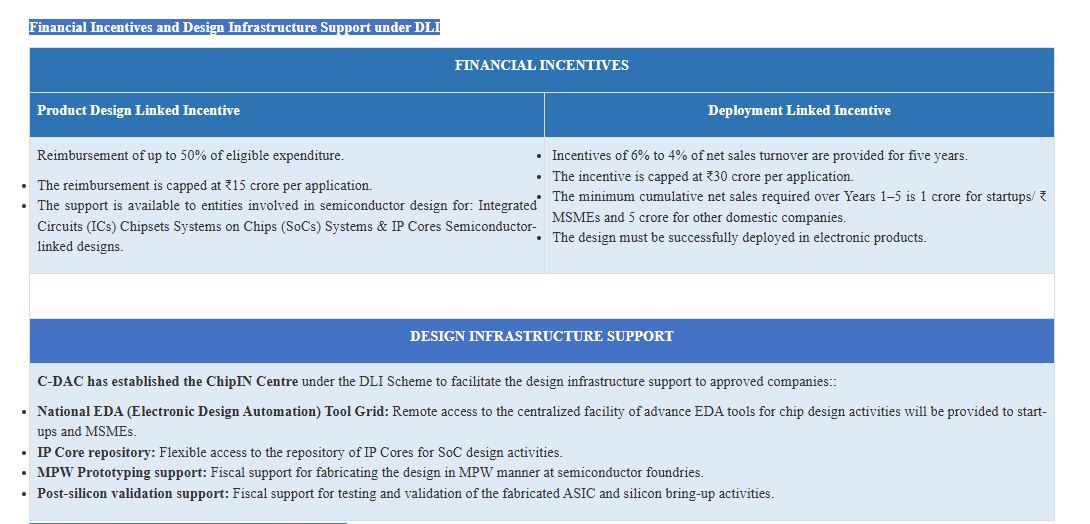
Since its launch in December 2021, the Design Linked Incentive (DLI) Scheme has been instrumental in shaping a stronger and more self-reliant semiconductor design ecosystem in India. By extending financial incentives, access to advanced design tools, and prototyping support to companies, startups, and academic institutions, the scheme enables innovators to progress seamlessly from ideas to actual silicon chips. The creation of a shared national infrastructure for chip design has anchored this ecosystem-driven approach.
The enabling measures have translated into tangible outcomes for the domestic startup ecosystem.
Supported companies under the DLI Scheme have moved from innovation to execution, with 10 patents filed, 16 chip designs tape-out completed, and 6 semiconductor chips successfully fabricated--marking critical milestones from concept to silicon. At the same time, over 1,000 specialised engineers have been trained or engaged through DLI-supported projects.
With an outlay of Rs 76,000 crore, India's semiconductor mission supports investments in semiconductor and display manufacturing as well as the design ecosystem. The DLI Scheme operates under this programme, providing end-to-end support for design, fabrication, and productisation. C-DAC, a premier R&D organisation under MeitY, is responsible for implementing the DLI Scheme as the Nodal Agency.
In conclusion, the government said that the Design Linked Incentive (DLI) Scheme is critical to anchoring India in the most strategic and value-intensive segment of the global semiconductor value chain--chip design.