US National Security Strategy document attaches India as a key partner: MEA
Dec 08, 2025
New Delhi [India], December 8 : The Ministry of External Affairs on Monday welcomed the newly released US National Security Strategy 2025 report, noting New Delhi's strategic importance to Washington and identifying India as a key partner in global security and strategic initiatives.
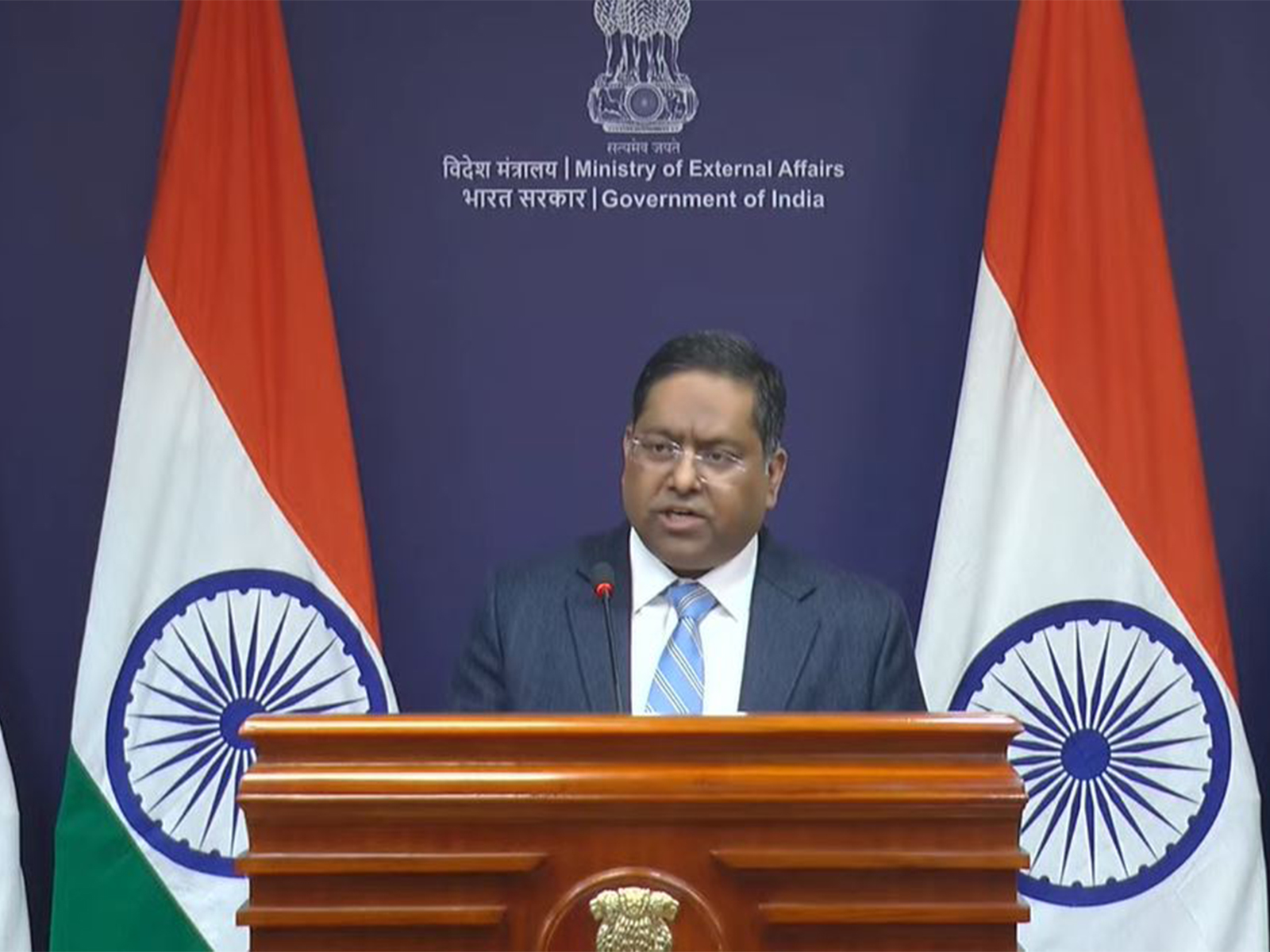
During a weekly media briefing, MEA Spokesperson Randhir Jaiswal stated that the US report attaches India as a key partner in the bilateral comprehensive global strategic partnership.
"The report that you mentioned reflects and underscores the importance that the United States attaches to India as a key partner. We have a multifaceted relationship with the United States. Both countries enjoy a comprehensive global strategic partnership and continue to work to further strengthen these ties," Jaiswal said.
Last week, the White House released the US National Security Strategy 2025, which positioned India as a critical partner, signalling Washington's intent to deepen cooperation with New Delhi across economic, technological and defence sectors.
The strategy document explicitly calls for improved commercial relations with India and encourages New Delhi to "contribute to Indo-Pacific security" through continued cooperation in the Quadrilateral Security Dialogue (QUAD) alongside Australia, Japan and the United States.
"We must continue to improve commercial (and other) relations with India," the document states, marking a significant diplomatic emphasis on the bilateral relationship.
The strategy identifies the Indo-Pacific as "already the source of almost half the world's GDP" and frames the region as amongst "the next century's key economic and geopolitical battlegrounds."
US officials have made clear their intention to work with treaty allies and partners - whose combined economies total USD 65 trillion - to counteract what the document describes as "predatory economic practices" in the region.
India, with its growing economy and strategic position, features prominently in this calculus. The administration has also emphasised technology cooperation, particularly in artificial intelligence, quantum computing, and defence technologies, as areas for enhanced partnership, and reaffirms the US commitment to quadrilateral cooperation through the Quad, which has emerged as a key diplomatic and security framework in the Indo-Pacific.
Meanwhile, on the bilateral counter-terrorism cooperation, Jaiswal also today highlighted the recently concluded 21st meeting of the India-US Joint Working Group (JWG) on Counter Terrorism (CT), noting it as a critical element of the India-US comprehensive global strategic partnership.
The MEA Spokesperson also stated that during the meeting, which was held on December 3, both sides strongly condemned the April 22 terrorist attack in Jammu and Kashmir's Pahalgam as well as the recent terror incident near the iconic Red Fort in Delhi on November 10.
Both sides also renewed their commitment to multilateral cooperation against terrorism at the UN, within the Quad framework, the Financial Action Task Force (FATF), and other forums.
"We had the 21st meeting of the India-US counter-terrorism working group meeting. This was held on the 3rd of December. We've also given a comprehensive readout of all that was discussed as part of this CT dialogue, which is very important. And it has been happening for several years now. Both sides attach high importance to counter-terrorism cooperation. It is an important element of our comprehensive global strategic partnership that we share with the United States," Jaiswal.
"The two sides strongly condemned the terrorist attack in Pahalgam, as well as the recent terror attack that happened in Delhi. The two sides renewed their commitment to strengthening multilateral cooperation in the fields of terrorism, including at the UN, within the format of the Quad, as well as in the format of the Financial Action Task Force and several other multilateral forums where we discuss and continue to discuss these aspects," he added.
Earlier, the MEA in a statement on Saturday stated that duirng the JWG, India and the US unequivocally condemned terrorism in all its forms and manifestations, including cross-border terrorism and renewed their commitment to strengthening multilateral cooperation in the field of countering terrorism, including in the UN, Quad and the Financial Action Task Force (FATF).
The two sides also called for additional designations of ISIS and al-Qa'ida affiliates, and Lashkar-e-Tayyiba (LeT) and Jaish-e-Mohammad (JeM) and their proxy groups, supporters, sponsors, financiers and backers, under the UN 1267 sanctions regime, ensuring their members face a global asset freeze, travel ban, and arms embargo.
"Both sides emphasised that confronting terrorism requires concerted action in a sustained and comprehensive manner. Against this backdrop, the two sides renewed their commitment to strengthening multilateral cooperation in the field of countering terrorism, including in the UN, Quad and the Financial Action Task Force (FATF). The two sides called for additional designations of ISIS and al-Qa'ida affiliates, and Lashkar-e-Tayyiba (LeT) and Jaish-e-Mohammad (JeM) and their proxy groups, supporters, sponsors, financiers and backers, under the UN 1267 sanctions regime, ensuring their members face a global asset freeze, travel ban, and arms embargo. Underscoring the growing convergence between India and the United States on counterterrorism, the Indian side thanked the U.S. Department of State for designating The Resistance Front (TRF), a proxy of LeT, as both a Foreign Terrorist Organisation (FTO) and a Specially Designated Global Terrorist (SDGT)," the statement read.