"India will have an extraordinary trajectory with AI, and we want to be a partner," says Google CEO Sundar Pichai
Feb 18, 2026
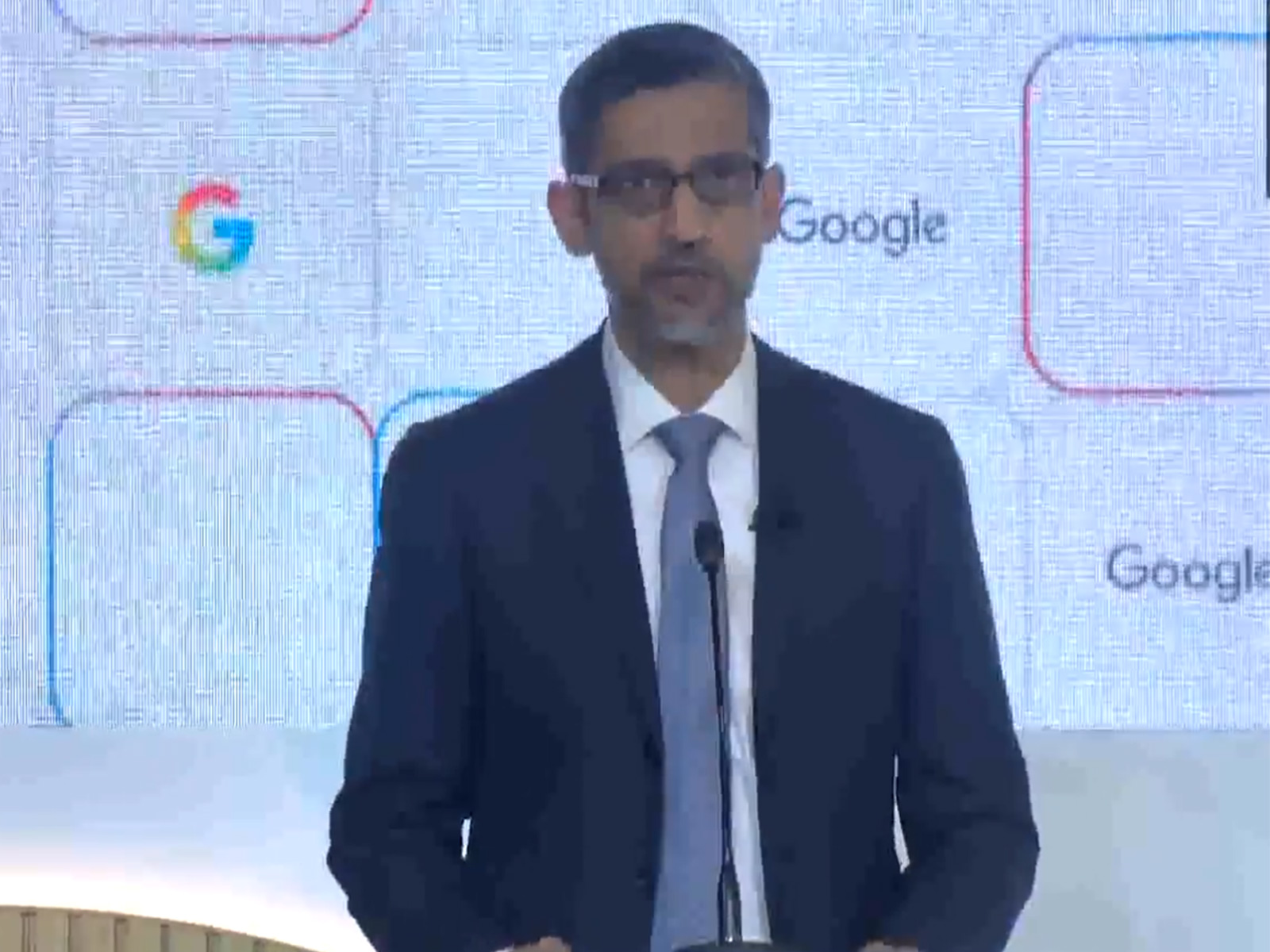
New Delhi [India], February 18 : Google CEO Sundar Pichai on Wednesday said that AI was the biggest platform shift in our lifetime and that India stands to have an extraordinary trajectory with this technology.
Speaking at a special event hosted by Google on the sidelines of the AI-India Impact Summit Pichai said that Google wants to be a partner with India in its AI journey.
"I believe India is going to have an extraordinary trajectory with AI, and we want to be a partner. AI is the biggest platform shift of our lifetimes and one of the most powerful tools to solve problems and improve lives at planetary scale. Whether it's making diseases more detectable and treatable, communities more resilient, or learning more accessible. For countries like India, AI presents a chance to leapfrog age-old gaps and create new opportunities. These also happen to be the places where we see the greatest adoption and optimism for AI technologies, which I don't think is a coincidence. Google has been investing in AI for more than a decade because we see it as the most important way to advance our mission," he said.
Pichai also announced the India America Connect initiative, which will deliver new subsea cable routes to increase AI connectivity along with several other initiatives of Google.
"Indian users are among the highest global adopters of voice and visual search. In the coming weeks, you'll see an enhanced model that powers Search Lite, our real-time voice and camera tool, so more people can search what they see in their own language. AI is also helping to create net new experiences that are truly helpful. The Gemini app, our personal AI assistant, is growing rapidly across the world, and India is among our largest markets. It's available in 10 languages spoken in India. Underlying this progress is a world-class infrastructure. Last year, we announced a $15 billion AI hub in Vizag. This hub will house gigawatt-scale compute and a new international subsea cable gateway. When finished, it will bring jobs and the benefits of cutting-edge AI to people and businesses across India," he said.
"Building on this, today we are announcing the India America Connect initiative, which will deliver new subsea cable routes to increase AI connectivity between the US, India, and multiple locations across the Southern Hemisphere. To take advantage of the opportunities this infrastructure creates, we must also invest in people and skilling. Which is why we're announcing some of our most ambitious skilling programs here. This includes a new Google AI Professional Certificate program to help people master AI in their work. In India, we are partnering with Wadhwani AI to reach students and early career professionals. Globally, we'll partner with governments, educational institutions, employers, and nonprofits. It will be available in English and Hindi with more Indian languages to follow. To deliver this impact at scale, transformation needs to happen in all sectors, " Pichai added.
Pichai also announced a key partnership between Google DeepMind and the Government.
"Today we are excited to announce a partnership between Google DeepMind and the Indian government as part of the Global National Partnerships program. This will broaden access to frontier AI capabilities for national priorities. Demis will share more later on. We're also partnering with Atal Tinkering Labs to bring GenAI assistants to over 10,000 Indian schools and 11 million students with a focus on robotics and coding in the classroom. Google has a full-stack commitment to India, and I've never been more excited about the future we are building together," he said
Pichai said that he reckons that India is going to be a full stack player in the Ai sphere and that puts India in a great position.
"India is unique... you know uniquely positioned in this moment. I think it has a chance to play a big role in all three, all three. I think of Google as a full-stack company and I think India obviously is going to be a full-stack player in AI. I think what's important to be in a position to do that, and I think that's what this AI summit is about, you have to make sure you're investing in all the foundational things you need. In the research, in knowledge, in the institutions you have here. The government playing a role in diffusing AI across the country and the economy and making sure it's reaching people. That means you're adopting it in all the sectors and in a way that the progress is touching the average person on a day-to-day basis. Be it a farmer, be it a student, be it a doctor in the healthcare sectors etc. And I think, I think the foundation is being laid and I can see it, you've seen the announcements this week in terms of infrastructure investments alone. So I think that puts India in a good position to get there. But I would say the progress is about diffusing the technology, and I think India can play a role in all three categories," Pichai said.
Pichai said he expects every sector and every context, every workflow to be transformed by AI.
"We're partnering with AIIMS in India as an example as to how can we work for patients to kind of input their symptoms or give the information, and the AI creates a report to help assist doctors. We are in early stages of projects like this. But to me, leapfrog means in each of these sectors, you've radically transformed how the workflow happens. I mean, how do students learn? How do your hospital systems work? How is government more efficient in a deep foundational way? I do think in areas like science, I think one of the things Demis and his teams have been focused on is how do you accelerate scientific discovery at a fundamental level? I think we are talking about a technology here which will allow you to create new things at some incredibly fast trajectory," he said.
The India AI Impact Summit 2026 is delivering focused, outcome-oriented results aligned with national priorities. The Summit is advancing practical AI deployment, policy coherence, and institutional coordination to ensure effective implementation across government and industry. It is strengthening governance and regulatory frameworks, assessing regional preparedness for AI-led industrial growth, and accelerating skill development and workforce transition.